👉 Photobiomodulation: How Light Therapy Supports Healing
Apr 10, 2026Have You Ever Felt Dismissed by Conventional Medicine?
If you’ve ever felt frustrated by conventional approaches to healing, you’re not alone.
Too often, people are told their symptoms have no real solution—that they should simply manage their condition rather than truly recover and thrive.
But that’s not the whole story.
Emerging science is revealing powerful ways to support the body’s natural healing processes—approaches that go beyond pharmaceuticals and instead work with your biology, not against it.
One of the most exciting of these therapies is photobiomodulation (PBM)—also known as healing with light.
What Is Photobiomodulation?
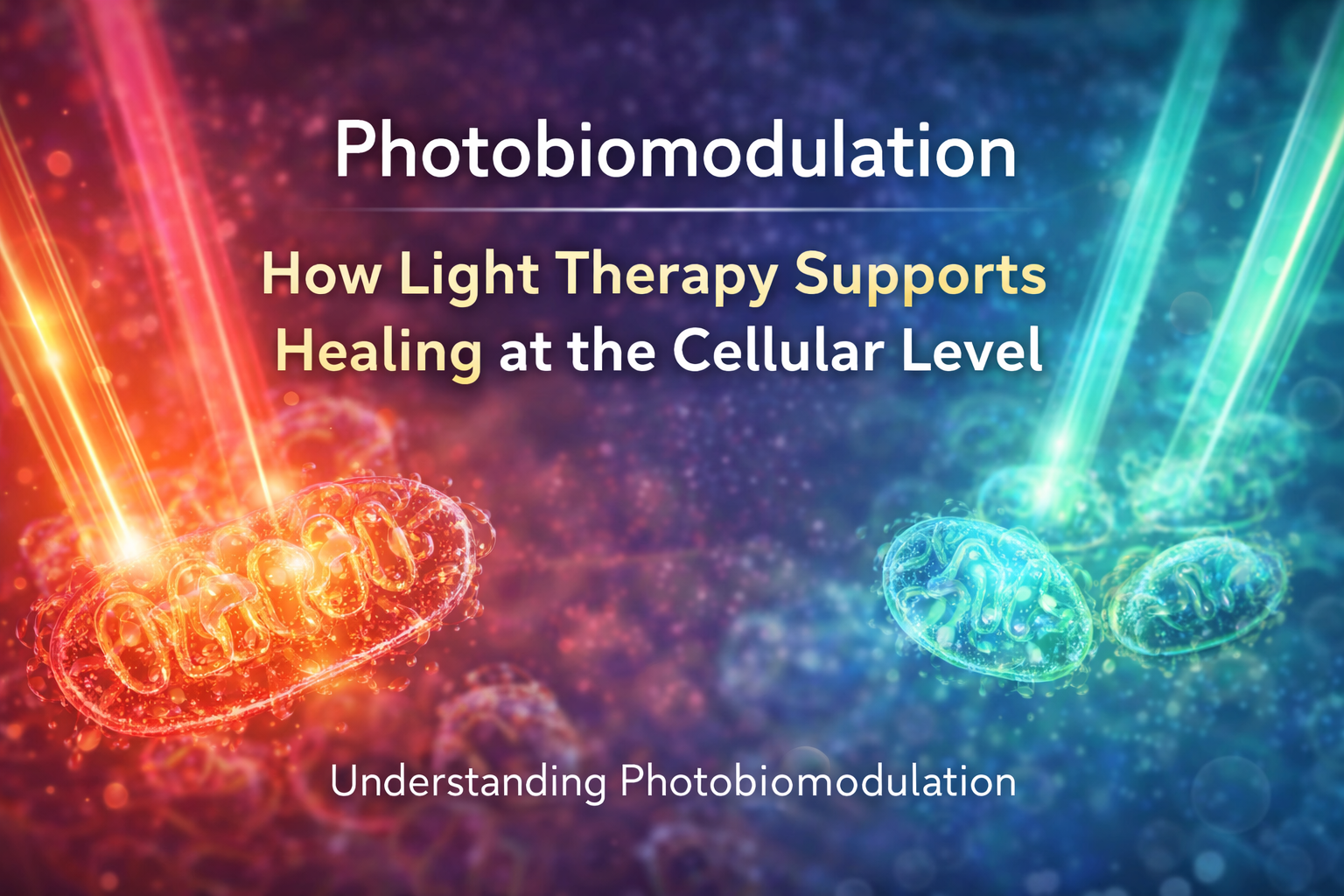
Photobiomodulation (PBM) is a non-invasive therapy that uses specific wavelengths of light to stimulate biological activity at the cellular level.
Unlike treatments that suppress symptoms, PBM works by enhancing your body’s own ability to repair and regulate itself.
Research has shown that PBM may help:
- Reduce pain
- Enhance tissue repair
- Regulate inflammation
- Improve circulation
- Support overall cellular function
All without medication or surgery.
How Does Light Therapy Work?
Light doesn’t just sit on the surface of your skin—it penetrates deep into your tissues, where it interacts directly with your cells.
At the center of this process are your mitochondria—the tiny energy-producing structures often referred to as the “power plants” of the cell.
When specific wavelengths of light are absorbed:
- Mitochondria increase production of ATP (cellular energy)
- Cells gain more energy for repair and regeneration
- Oxidative stress is reduced
- Inflammation is regulated
- Circulation improves
In addition, photobiomodulation can activate key systems in the body, including:
- The immune system
- The lymphatic system
- The nervous system
The result is better healing, less pain, and improved cellular function—powered by light.
The Science Behind Different Light Wavelengths
Different wavelengths of light affect the body in unique ways. Here’s how some of the most studied light frequencies work:
Red & Near-Infrared Light
- Stimulates collagen production
- Improves skin elasticity
- Supports wound healing and tissue repair
- Reduces signs of aging
Blue Light
- Helps improve acne, psoriasis, and other inflammatory skin conditions
- May reduce scarring
- Supports mood regulation
- Helps regulate the sleep-wake cycle
Green Light
- May reduce pain sensitivity
- Helps calm neuroinflammation
- Supports mitochondrial energy production
- Has been FDA-approved for certain body contouring applications
Why This Matters for Chronic Symptoms
If you’re dealing with:
- Chronic pain
- Fatigue
- Inflammation
- Slow healing
- Skin conditions
…it’s worth considering that your body may not be lacking medications—it may be lacking the right signals to heal.
Photobiomodulation provides one of those signals.
Where to Learn More
If you’d like to explore further, here are a few trusted resources:
- Let There Be Light: How Light Frequencies Help Create Healthy Cells (NASA research)
- Photobiomodulation for Brain Disorders – Dr. Michael Hamblin
- Experience PBM therapy at Carpathia Wellness Center
Final Thoughts
The human body is designed to heal—it simply needs the right inputs.
Light is more than something we see—it’s something our cells respond to at the deepest level.
From reducing pain to improving energy and tissue repair, photobiomodulation is emerging as a powerful, science-backed tool for restoring health.
If you’ve been searching for answers, this may be one approach worth exploring.
Stay curious. Keep asking questions. And remember—healing often begins when we’re willing to look deeper.
Always have hope for your health and healing. 🌿
Want to understand what’s really driving your symptoms?
Many of the issues we’ve discussed—whether it’s hormone imbalance, inflammation, chronic pain, or toxin exposure—share a deeper connection with metabolic signaling and appetite regulation.
One of the most important pathways involved is GLP-1, a hormone that influences:
- blood sugar balance
- inflammation
- satiety and cravings
- energy metabolism
When GLP-1 signaling is disrupted, it can make symptoms worse—and healing much harder.
That’s why we created a free 95-page guide to help you understand how to naturally support these pathways and start addressing root causes.